Claude Architect Professional Certification: The Complete Exam Study Guide
One guide to all five modules: solution design, production engineering, responsible AI, stakeholder communication, and team enablement—with diagrams, practical examples, and a revision checklist.

Preparing for the Claude Architect Professional certification means connecting several kinds of judgment. You need to decide where AI belongs, prove that a system works, control what it can do, explain the tradeoffs, and leave a team capable of operating it.
This guide connects solution design, production engineering, responsible AI, stakeholder communication, and team enablement. My focus is the reasoning behind an architectural choice: what constraint makes it the right choice, what could fail, and what evidence would make the decision defensible?
Table of contents
How to approach the exam material
An architecture scenario can have several plausible solutions. Recognizing a technology is only the first step. The stronger answer connects the choice to the requirement that matters most.
For each scenario, ask:
- What outcome does the business need? Name the user, the task, and the current baseline.
- What is the binding constraint? It could be accuracy, latency, cost, data handling, or the consequence of a wrong action.
- Who owns each decision? Separate Claude’s interpretation from system enforcement and human accountability.
- How will we prove it works? Name an evaluation, an operational measure, or a control with evidence.
- What happens when it fails or changes? Include a safe fallback, an owner, and a way to reverse the change.
A useful answer structure is: choose the option, name the deciding constraint, explain the rejected alternative, and identify the validation gate.
Four AI Fluency competencies underpin this work: delegation determines what to assign to AI; description makes the task and constraints explicit; discernment judges the output; and diligence preserves accountability for its use.
Module 1 — Claude Platform & Solution Design
Core question: What should Claude own, and what architecture fits the work?
Design around the model’s properties
Design around four model properties: next-token prediction, knowledge, working memory, and steerability. Each has an architectural consequence.
| Property | What it means for a design |
|---|---|
| Next-token prediction | Fluent output can be incorrect, and repeated runs can differ. Verify important facts and evaluate representative behavior. |
| Knowledge | Private, rare, or rapidly changing information needs an authoritative external source. |
| Working memory | Context is finite. Select relevant inputs and reserve room for tool results and output. |
| Steerability | Instructions and examples shape behavior, but untrusted content can also try to redirect it. Separate instructions from data and enforce permissions in code. |
A successful demonstration is evidence that a task may be possible. It is not proof of determinism, completeness, or production reliability.
Decompose before choosing technology
Assign language interpretation, summarization, extraction, and drafting to Claude where they add value. Keep exact calculations, identity checks, transactions, and business rules in the systems that own them. Keep consequential judgment and exceptions with accountable people.
For example, an order-support assistant can interpret a customer’s message and draft a reply. The order service supplies the current shipping status. A policy service decides whether a refund is allowed. The payment service executes an authorized refund, with human approval when the policy requires it.
This separation prevents a common mistake: asking the model both to interpret an ambiguous request and to enforce a rule that must never be bypassed.
Choose the least autonomy that satisfies the task
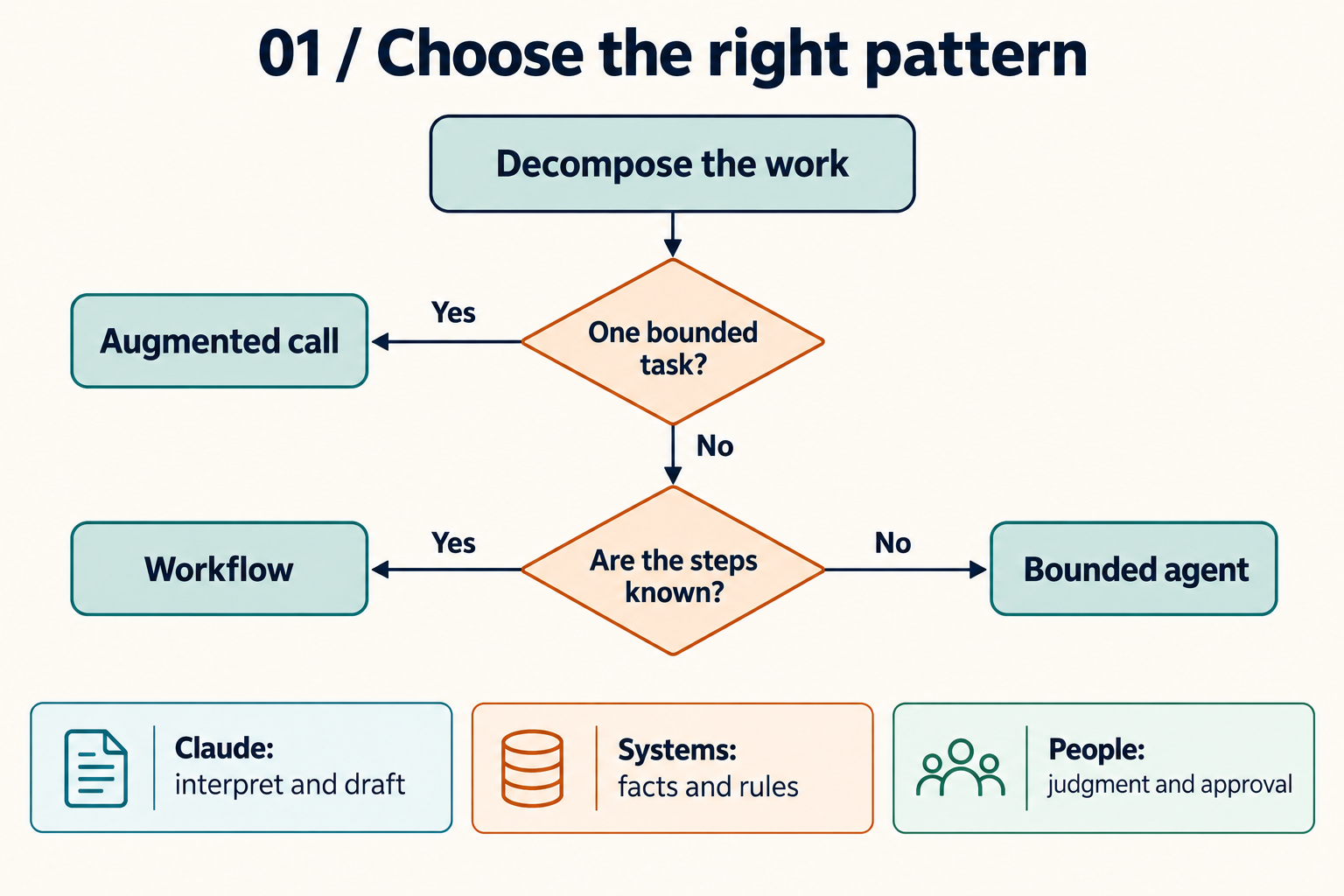
Figure 1. Pattern selection begins with decomposition. Cost, error consequences, latency, and observability can rule out a pattern even when its shape fits. Select the image to enlarge it.
An augmented call handles a bounded task with access to the necessary context or tools. A workflow defines the overall control flow in advance. An agent chooses its next steps from what it discovers.
Recognize the four workflow shapes:
- Chaining: Extract information, classify it, and then draft a response.
- Routing: Select a specialist path based on the request.
- Parallelization: Process independent units and reconcile the results.
- Evaluator–optimizer: Generate, evaluate, and revise within explicit stopping limits.
Choose among them using predictability, error cost, observability, latency, and spend. An agent is appropriate when discovering the path is part of the task, provided the system can bound and inspect that autonomy.
Separate retrieval from live state
Use retrieval-augmented generation (RAG) to ground answers in reference documents. Use tools against the system of record for current account balances, inventory, shipment status, or transactional eligibility.
Retrieval still needs engineering. Chunk documents along useful boundaries, retain source and version metadata, enforce access controls, and evaluate retrieval separately from answer generation. Semantic retrieval helps with paraphrases; keyword retrieval helps with exact identifiers. Hybrid retrieval and reranking can improve relevance when their cost and latency are justified.
Common reference architectures include agents, RAG, document processing, routing, and coding agents. Combine patterns when different parts of the workload require different controls; avoid adding components simply because they are available.
Treat model and context choices as release decisions
Use Sonnet as a balanced starting point, with evaluation evidence determining whether a workload benefits from Opus or can meet its requirements with Haiku. This is a selection method, not a claim that one tier always wins.
Version the prompt–model pairing. Before changing either, define the quality threshold, evaluate difficult cases, measure latency and cost, and set rollback criteria.
For context, prefer a deliberate budget:
- Load relevant material progressively.
- Use a large initial context only when the input is bounded and it earns its cost.
- Compact history carefully, preserving decisions, constraints, and unresolved work.
- Keep durable state outside the conversation and retrieve it when needed.
- Use extra reasoning effort where evaluation shows a useful improvement.
Prompt caching can help with repeated stable prefixes. It does not make stale business information current.
Keep platform layers distinct
An entry point is what the user interacts with: Claude.ai, Claude Code, or a custom application. A build-time interface is how engineers integrate: an API, SDK, or protocol such as MCP. A delivery route is where requests are served under the chosen infrastructure and commercial arrangement.
Choose the entry point for the user, the interface for the integration, and the route for operational and governance constraints. Claude Code fits engineering work; a nontechnical operations team may need an approved ready-made interface or a custom application.
Tools connect capabilities. MCP can make integrations reusable across compatible clients. Skills package procedures. Subagents isolate scoped work and context. Hooks can run deterministic checks at defined events. None replaces server-side authorization.
Remember: decomposition first, autonomy second, authoritative context third, and evidence before a model change.
Module 2 — Enterprise Integration & Production
Core question: Can this design meet quality, cost, latency, and reliability requirements under real conditions?
Define evaluations before production code
Write measurable acceptance criteria before implementation makes assumptions difficult to change. A golden dataset should represent the input distribution, including missing information, unusual formats, difficult cases, and adversarial inputs.
Use the cheapest reliable grading method:
- Code-based checks for schema validity, exact values, required fields, and other unambiguous conditions.
- Model-based judges for interpretation, using a clear rubric, constrained verdicts, and calibration against human labels.
- Human review for consequential or novel judgments that automated graders cannot yet assess reliably.
Judge outputs are also fallible. Check agreement with human assessments and inspect disagreements. Avoid relying on a model’s preference for its own answers.
The evaluation sequence is: define the task, assemble representative cases, run deterministic checks, judge the interpretive dimensions, and act on both aggregate and category-level results. Multi-turn systems need conversation-level cases: isolated prompts cannot prove that an assistant remembers constraints or handles follow-up questions correctly.
Keep regression cases when updating the suite. Do not rewrite expected results simply to make a new prompt pass. Anthropic’s evaluation guidance provides a practical reference for measurable criteria and grading choices.
Close the gap between a prototype and production
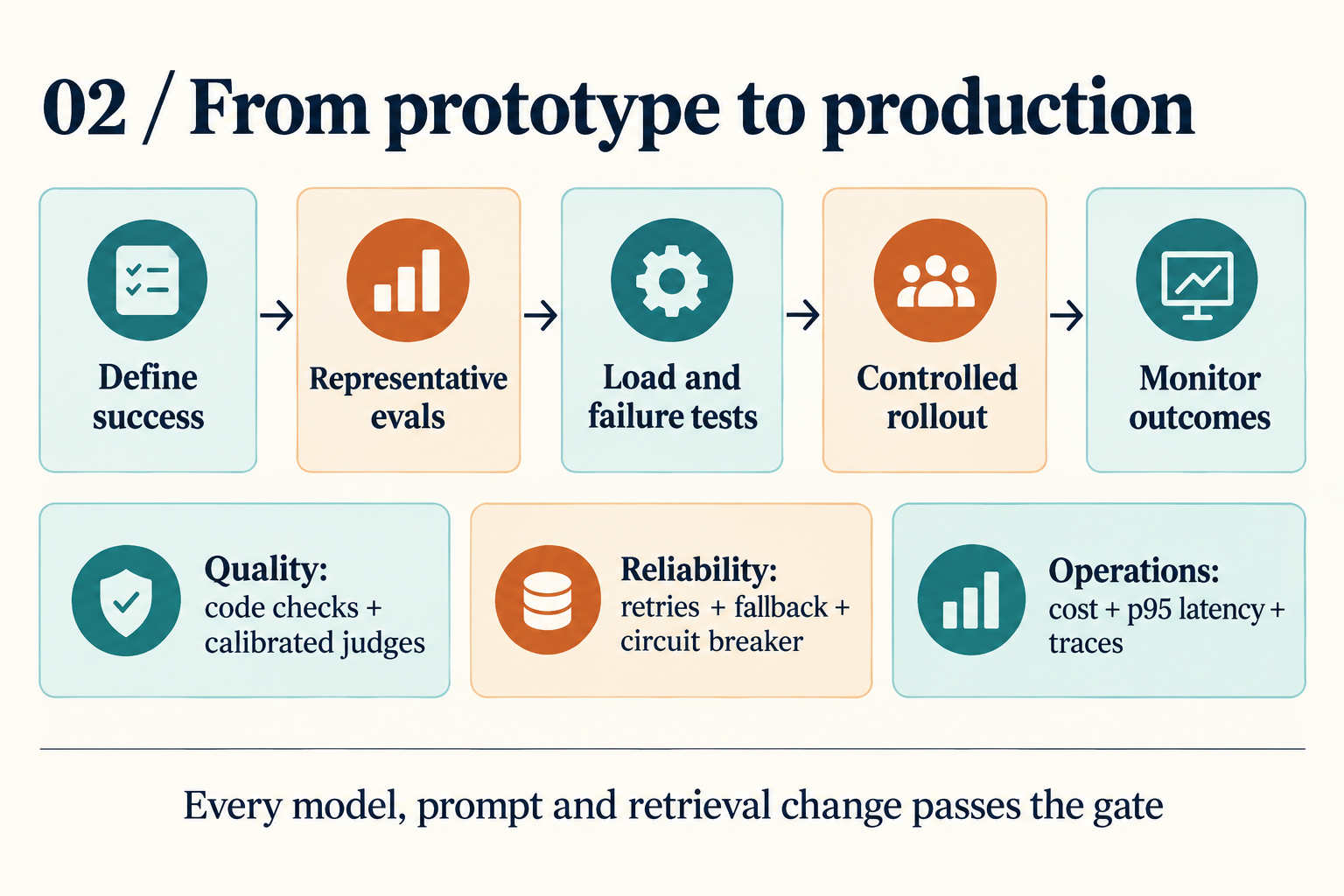
Figure 2. A release must satisfy behavioral and operational requirements. Select the image to enlarge it.
A prototype proves capability on a sample. Production adds concurrency, imperfect inputs, dependency failures, and financial limits.
Measure p95 latency under representative load: 95% of requests complete at or below that value. A fast median can hide an unacceptable slow tail. Include retrieval, queues, tools, screening, and downstream processing in the end-to-end budget.
Model cost from the distribution of work, not only a typical request:
Monthly inference cost = uncached input cost + cache-write cost + cache-read cost + output cost.
Then add retrieval, tool execution, infrastructure, evaluation, and human review. Count all model calls within a business task, including retries and agent turns. Test sensitivity to higher volume, longer inputs, lower cache reuse, and a higher exception rate.
Caching helps repeated stable context; batch processing may help when the deadline permits asynchronous completion. Neither should be assumed beneficial without checking the workload and current feature terms.
Put reliability controls at the correct boundaries
Bounded retries with exponential backoff and jitter belong near transient calls. A circuit breaker protects a service boundary from repeatedly calling an unhealthy dependency. An approved fallback belongs in orchestration, where the system can select a safe degraded behavior.
Fallback must preserve the original constraints. Returning an unavailable status or queuing work can be better than silently switching to a route that lacks the required controls. For side-effecting actions, retries also need idempotency or reconciliation so a timeout does not cause a duplicate transaction.
Match controls to the architecture:
| Architecture | Failure to anticipate | Control to design |
|---|---|---|
| Agent | Unbounded tool use, context growth, or failure to stop | Tool, token, time, and turn budgets; explicit stop conditions |
| RAG | Missing, irrelevant, stale, or unauthorized evidence | Retrieval evaluations, index maintenance, provenance, access filters |
| Document pipeline | Wrong extraction moves downstream as valid data | Field validation and an exception path to review |
| Orchestrator and workers | A missing result disappears inside a plausible synthesis | Shared traces, recoverable failure rules, and submitted-versus-completed reconciliation |
Pin model versions where supported and keep an update and rollback runbook. Treat prompts, retrieval configuration, and shared skills as versioned production dependencies too.
Scope feasibility and value together
A defensible feasibility result is feasible as scoped, feasible with constraints, or not feasible as described. The conditions are part of the answer: accepted input size, workload volume, response deadline, budget, required sources, and human-review capacity.
Average daily volume does not establish peak concurrency. Document page count does not reliably establish token count. Measure both with representative inputs before committing.
The value case should use the business owner’s baseline. Compare the same unit before and after deployment—minutes per case, rework rate, or time to resolution—and include remaining review labor.
Net monthly benefit = measured operational benefit − recurring operating cost.
If that benefit is positive, an illustrative payback estimate is build cost divided by net monthly benefit. Report assumptions and a sensitivity range; saved staff time is not automatically a realized cash saving.
Integrate identity, permissions, data, and observability
Authenticate users at the server. Enforce their permissions in retrieval and tool execution. A role written into a prompt provides context; it is not an access-control boundary.
Minimize sensitive data before model calls and application logging. Preserve tenant isolation through storage, retrieval, authorization, traces, and usage attribution. Tenant-specific credentials or quotas may help, but a separate key alone does not establish data isolation or guarantee separate provider limits.
Record enough to diagnose a request: correlation ID, model and prompt version, token usage, latency, stop reason, retrieval and tool activity, and downstream acceptance or rejection. Protect the audit record itself with redaction, restricted access, and an appropriate retention policy.
Improve with structured experiments
Predefine the hypothesis, primary metric, guardrails, assignment unit, and sample-size assumptions. Keep assignment stable within a conversation. Review both practical effect size and uncertainty; an attractive result from a small convenient sample is not sufficient evidence.
Shadow testing runs a candidate on copied traffic while users receive the current system’s response. It reduces exposure but does not measure how users would react to the candidate, and it does not solve an insufficient-sample problem. Shadow tools must not repeat real writes.
A live A/B test measures user-facing outcomes but exposes some traffic to the candidate. Use it only after the required validation and with bounded risk and rollback.
Remember: a green average score, an inexpensive demo, and a low error rate can all coexist with a failing production system.
Module 3 — Responsible AI, Safety & Risk for Architects
Core question: What stops a technically working system from disclosing data, taking an unauthorized action, or producing an unjustified outcome?
Distinguish model safety from application policy
The model’s trained behavior can reduce broad classes of harm. It does not know an organization’s account-access rules, approval thresholds, or retention obligations.
Think in layers: trained behavior, system instructions, runtime screening, and authorization. Instructions guide the model. Runtime controls enforce the deployment’s boundaries. A statement such as “never show another customer’s records” is incomplete unless retrieval and tools enforce that rule.
Screen content and authorize actions separately
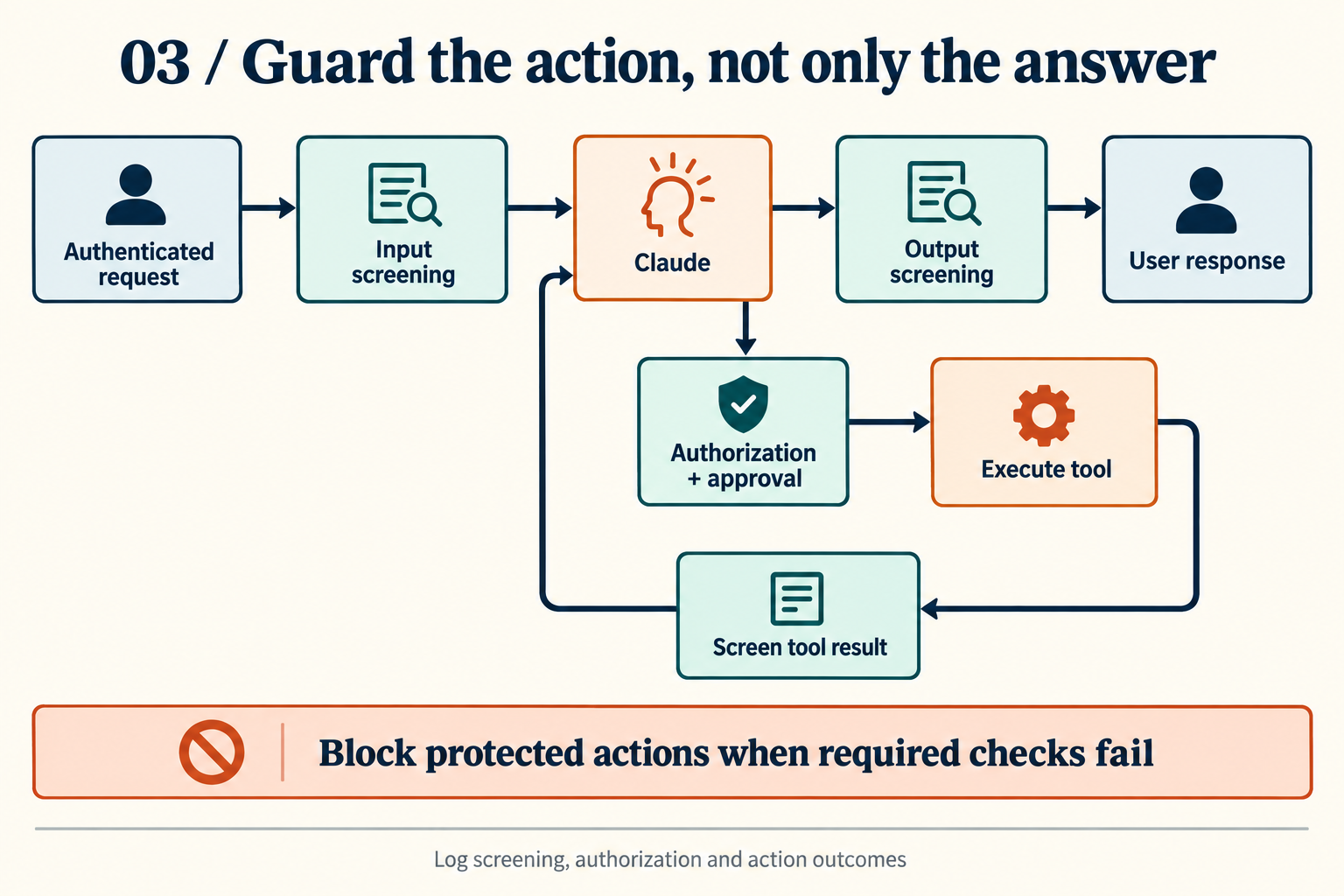
Figure 3. An output filter cannot undo a tool action. Authorization and any required approval precede execution; tool results re-enter as untrusted data. Select the image to enlarge it.
Input screening asks whether content should reach the model. Output screening asks whether an answer is appropriate to return. Tool authorization asks whether this identity may perform this action on this resource now.
Use deterministic checks for defined rules and permissions; use model-based checks for ambiguous language where appropriate. Neither is perfect coverage. For protected operations, decide explicitly how the system behaves when a required control fails: block or queue the action, record the failure, and provide a safe response.
Cover more than the user prompt
Key risks include direct prompt injection, indirect prompt injection, token-budget exhaustion, tool abuse, and data exposure.
Indirect injection may arrive in a document, an email, or a tool result after the initial request has passed screening. Treat that content as data, preserve trust boundaries, restrict capabilities, and screen it where useful. A detector should supplement these controls, not become the only defense. Anthropic’s prompt-injection guidance includes testing attacks in documents and tool outputs.
Skills also introduce a supply-chain boundary. Review instructions and executable content before approval; investigate unexpected network access, credential reads, or operations unrelated to the stated purpose. Use trusted distribution, pinned versions, least privilege, and runtime confinement. Record an explicit approve, reject, or remediate verdict.
Make fairness and explanations inspectable
Unequal outcomes can enter through the retrieval corpus, prompt framing, few-shot examples, or downstream routing. Looking only at overall accuracy can conceal poor outcomes for a subgroup.
Evaluate meaningful subgroups where appropriate, inspect the evidence supplied to the model, and trace routing decisions. Different audiences need different explanations:
- An affected user needs an understandable reason and a route to correction.
- A reviewer needs evidence that comparable cases receive consistent treatment.
- An engineer needs the inputs, source references, versions, and decision path required to investigate.
Preserve observable evidence and decision reasons rather than treating hidden model reasoning as an audit artifact.
Route human review by stakes
Assess reversibility, the cost of being wrong, and calibrated uncertainty together. High confidence does not make an irreversible decision low stakes.
Use pre-action approval where a consequential action must not happen unreviewed. Post-action audit can suit reversible, lower-risk actions. Sampling monitors population-level quality; it does not protect every individual outcome.
Give reviewers the relevant source input, proposed output or action, reason for escalation, and clear approve, correct, or reject options. A queue that sends everything to an overloaded reviewer can produce approval fatigue instead of meaningful oversight.
Build a control register
For each obligation, record the control, accountable owner, and evidence that it operates.
| Illustrative obligation | Control | Owner | Evidence |
|---|---|---|---|
| Only authorized staff access case records | Server-side authorization and scoped retrieval | Identity and application teams | Denied-access tests and audit events |
| Protected actions require approval | Mandatory gate before execution | Workflow owner | Approval linked to the executed action |
| Data follows the approved processing boundary | Approved route and constrained routing configuration | Platform and governance teams | Configuration review and route records |
| Logs retain only approved data for the required period | Redaction, access limits, deletion policy | Data operations | Redaction tests and deletion evidence |
These are design examples, not a complete legal compliance checklist. Determine obligations and acceptable evidence with the organization’s responsible reviewers.
Also distinguish training use from retention. Data excluded from model training may still be retained under applicable product terms, feature behavior, or application logging. Verify the specific arrangement in the API retention documentation and commercial Privacy Center guidance, rather than asserting a universal retention rule.
Remember: a permitted delivery route is a starting condition. The controls, owners, and evidence make the actual deployment reviewable.
Module 4 — Stakeholder Communication, Solution Lifecycle & Go-to-Market
Core question: Can stakeholders make an informed decision, and can the design survive change and handoff?
Translate preferences into requirements
Discovery should establish what the system must do, must not do, must cost, and must prove.
“Make it seamless” could mean a latency limit, a single interface, no repeated data entry, or a clear exception handoff. Confirm the intended meaning instead of choosing one silently.
Record each stakeholder statement alongside the derived requirement, architectural consequence, and unconfirmed assumption. “A clinician reviews it” is incomplete until the required reviewer, approval authority, and timing are explicit. “Keep logs” is incomplete until content, access, and retention are agreed.
Present a decision stakeholders can defend
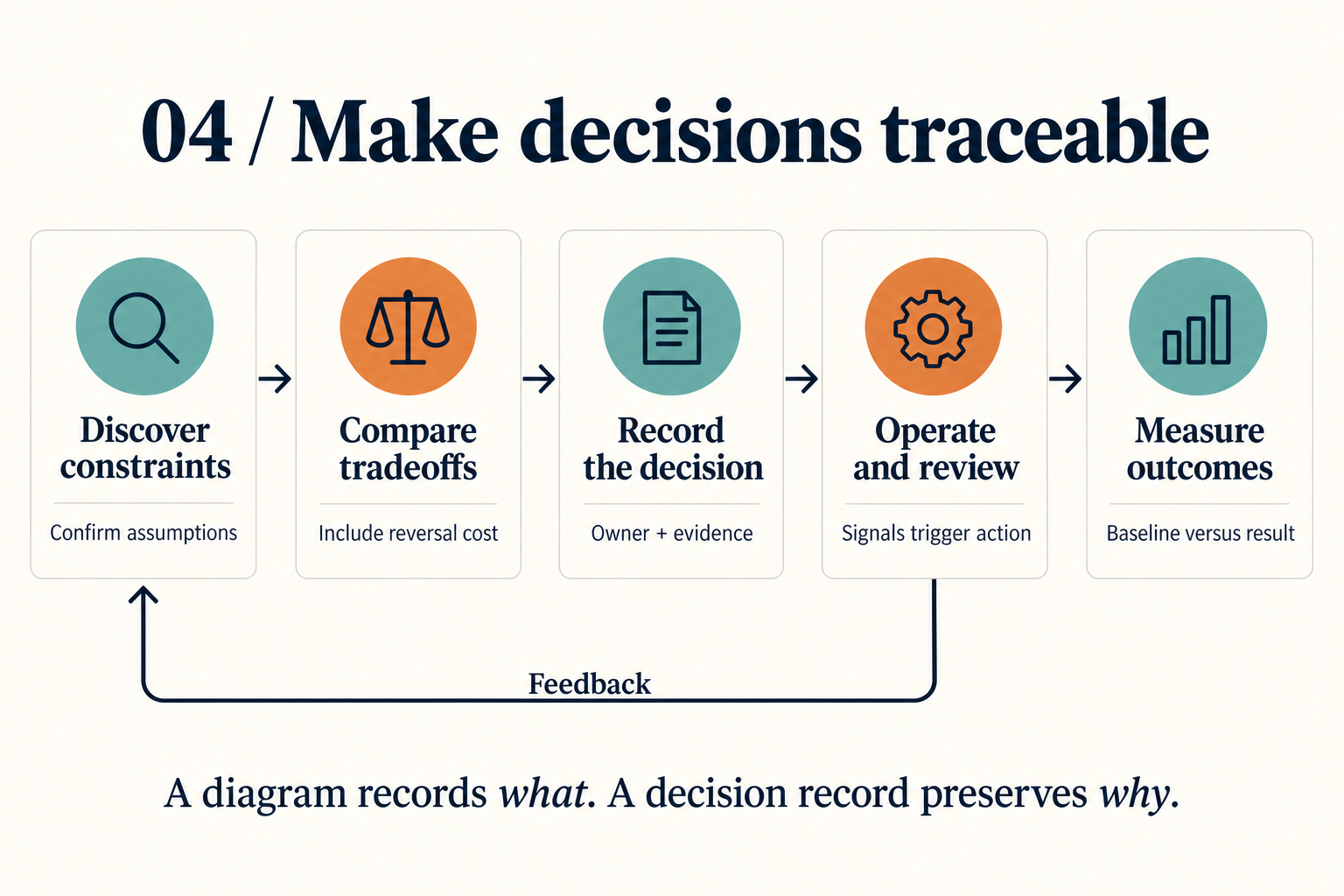
Figure 4. Preserve the reason for a decision so that a future team can change it safely. Select the image to enlarge it.
For each credible option, explain what it gains, what it sacrifices, and what reversing it later would cost. Add the governance consequence where it changes the decision.
For example, loading a whole playbook into every request may simplify a prototype but increase recurring cost and context noise as the material grows. Retrieval adds engineering work but gives more control over evidence selection and versioning. The decision needs the workload assumptions, not a universal claim that one is always superior.
A requirement such as mandatory audit evidence is not an optional feature to trade away for a small latency improvement. Optimize how it is implemented or renegotiate the requirement with its owner.
Turn monitoring into a feedback loop
Monitoring creates signals. A feedback loop assigns meaning and action:
Signals → triage → decision → action → review.
Define who responds when quality drifts, cost rises, or an SLA is breached. State what is measured, the breach threshold and window, and what response is owed. Derive thresholds from the business experience and acceptance criteria.
A short isolated latency spike may remain an operations issue. Persistent quality decline may require an architect to investigate retrieval, prompts, or input changes. A confirmed change to the business promise may need stakeholder review. Scheduled governance reviews should occur even when dashboards are green.
Document the why, the evidence, and the owner
A handoff should let an engineer who missed the design meetings make a safe change. Include:
- Scope, architecture, data paths, and integration boundaries.
- Dated decisions, rejected alternatives, and the constraints behind them.
- Assumptions and open items with owners and resolution criteria.
- Evaluation results, model and prompt versions, release and rollback procedures.
- Control register, evidence locations, support runbooks, and escalation contacts.
A diagram shows the final arrangement. It rarely explains why an apparently simpler alternative was rejected.
For deployments spanning delivery routes, document which workload uses which route and why. Verify feature, model, region, identity, and logging differences before relying on parity. Avoid a failover path that silently changes the processing boundary.
Measure outcomes in business units
An outcome record should name the use case and scope, before metric, after metric, auditable control, measurement owner, and reuse potential.
“More requests completed” is a technical signal. “Review time fell while the rework rate stayed within the agreed threshold” connects the system to a business result. Include the measurement window and assumptions so a sponsor can assess the claim.
Connect architectural decisions to stakeholder conversations
In demos and scoping conversations, demonstrate the stakeholder’s actual scenario, state limits honestly, and bring clear requirements and open questions. Address objections with evidence about the proposed design and its tradeoffs.
For revision, focus on discovery, tradeoff reasoning, feedback loops, documentation, route responsibilities, and outcome evidence.
Remember: a decision is incomplete when stakeholders know its benefits but cannot explain its costs or constraints.
Module 5 — Team Enablement & Operational Productivity
Core question: Can the team adopt the system consistently and operate it without depending on the original architect?
Establish a shared baseline
A team needs common project guidance, approved tools and integrations, a permission posture, and ownership of configuration changes. For Claude Code work, establish shared project instructions such as CLAUDE.md, reusable skills, and centrally governed configuration.
Set model defaults, permitted model choices, reasoning-effort guidance, and spend controls before usage expands. Model choice and unbounded sessions multiply across a team.
Use champions and small cohorts to prove real workflows and collect feedback before broad rollout. Access alone does not establish adoption.
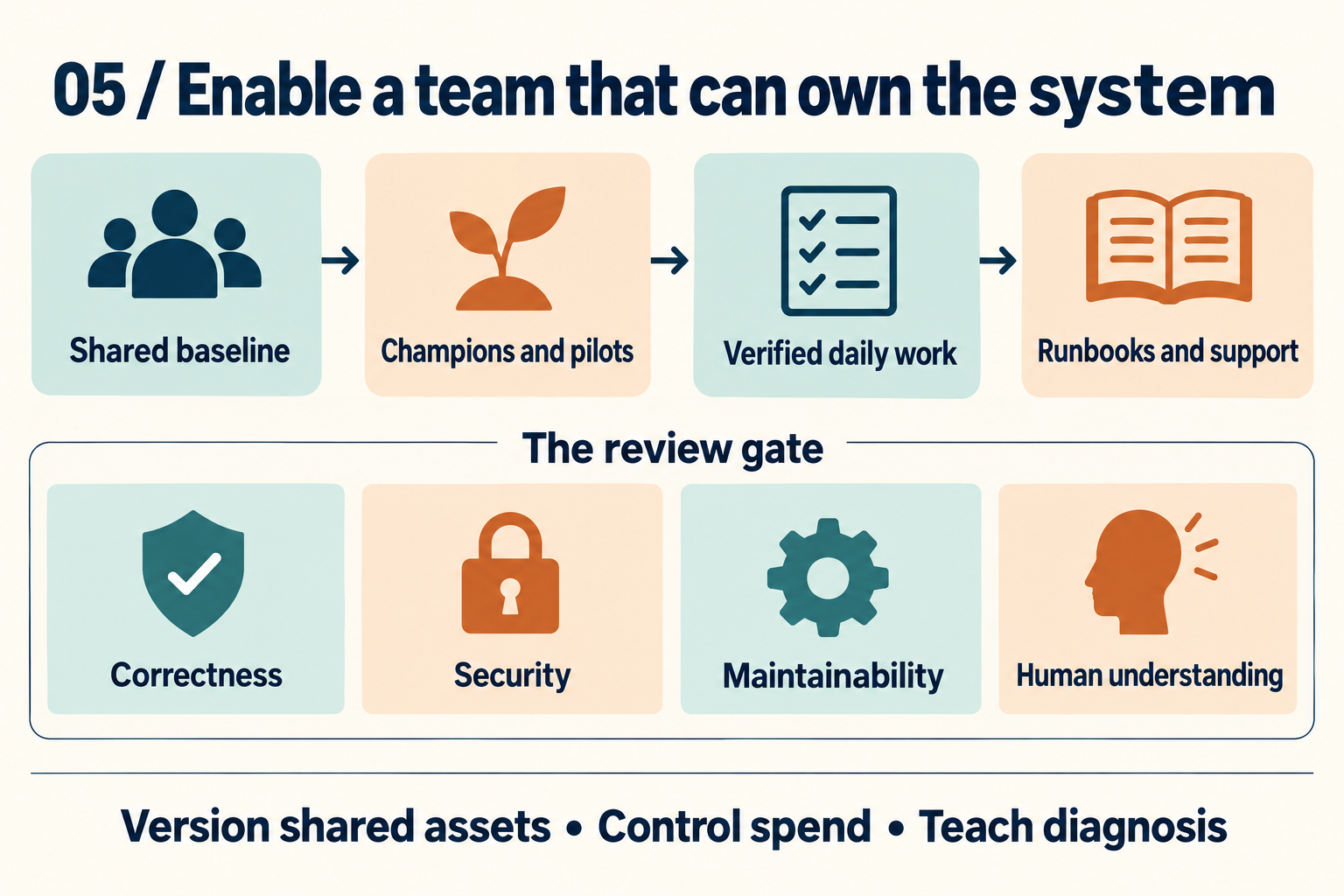
Figure 5. Adoption should increase useful output while preserving the review standard. Select the image to enlarge it.
Choose distribution by scope and governance
Distinguish an organization-wide skill, a group-targeted plugin, a repository-scoped skill, and a capability invoked programmatically by an application. They address different audiences and lifecycles.
A procedure confined to one codebase can version with that repository. A shared capability across teams needs an owner, controlled updates, and a rollback path. Managed settings govern environment policy; they are a separate concern from distributing a procedure.
Exact mechanisms vary across products and plans. For Claude Code, consult the current skills documentation, plugin documentation, and settings reference.
Integrate AI into actual development work
Look for repeated friction in code exploration, implementation, test generation, review preparation, documentation, and debugging. Package useful practices where developers already work.
Watch for two adoption failures: a few enthusiasts use the tooling while the team stays unchanged, or everyone remains at basic chat and never adopts repository-aware workflows.
Faster code generation increases the volume reaching review. It does not justify lowering the standard. A verification checklist should cover four dimensions:
- Correctness: Tests exercise the requirement, edge cases, and failure paths.
- Security: Inputs, permissions, secrets, and dependencies receive appropriate checks.
- Maintainability: The change fits the system and remains understandable to its owners.
- Human understanding: The person approving it can explain what it does and why.
Automate repeatable checks, but keep responsibility with the people who merge and operate the change.
Teach symptom-to-cause diagnosis
Operational support should improve the team’s ability to solve the next incident.
| Symptom | Investigate first | Durable follow-up |
|---|---|---|
| Latency rises | Token growth, tool delays, queues, concurrency, model changes | A trace-based diagnostic path and clear escalation threshold |
| Answers worsen without an application release | Corpus/index changes, changed inputs, prompt or model configuration | Retrieval and output regression cases |
| Spend jumps | Longer requests, additional turns, retries, cache misses, model selection | Usage attribution and budget controls |
| Tools fail | Credentials, scopes, schemas, rate limits, dependency health | A safe recovery procedure with named ownership |
| Agent output looks complete but omits work | Missing workers, timeouts, incomplete aggregation | Expected-versus-returned coverage checks |
These are hypotheses to investigate, not diagnoses to assume. A runbook should say what evidence to collect, what safe action to take, and when the issue must leave the team.
Remember: successful enablement produces a team that understands, verifies, and maintains the workflow—not merely a team with accounts.
Worked example: connect all five modules
Consider an illustrative supplier-onboarding assistant. Operations staff receive document packs, extract supplier details, compare them with an approved checklist, and prepare a recommendation. The supplier system owns current status. A procurement officer approves activation.
Module 1 — Design. Use an internal workflow: ingest, extract, retrieve relevant checklist requirements, validate, and draft. Claude interprets documents and explains missing information. The supplier service provides current records; deterministic rules enforce mandatory fields. A human owns activation.
Module 2 — Production. Evaluate extraction, evidence faithfulness, missing-field detection, and correct escalation on representative packs. Model long documents and retries, test peak load, and measure cost per completed onboarding. Never retry an activation blindly after a timeout.
Module 3 — Safety. Authenticate staff, enforce record access, and treat instructions embedded in uploaded files as untrusted. Authorize activation immediately before execution and require the procurement approval. Give the reviewer the source evidence and reasons for escalation. Protect both the model request and the audit trail.
Module 4 — Lifecycle. Confirm what “faster onboarding” means and measure the current baseline. Record why activation remains gated. Give each quality or cost threshold a response owner. Handoff includes alternatives, assumptions, controls, and rollback. Compare review time and rework before and after the pilot.
Module 5 — Enablement. Start with champions, distribute the approved procedure as a versioned asset, and teach the team how to investigate failed extraction and stale retrieval. Keep approval responsibility and spend limits explicit.
The architecture is defensible because each module answers a different question about the same system. Replacing every step with an unrestricted agent would not remove any of those responsibilities.
Rapid review and common traps
| Tempting answer | Better reasoning |
|---|---|
| Use the largest model everywhere | Evaluate the prompt–model pairing against quality, cost, and latency. |
| Use an agent because the task has many steps | Known steps often fit a workflow; dynamic discovery justifies agent autonomy. |
| Retrieve a recent account snapshot | Query the system of record when correctness depends on current state. |
| Put the user’s role in the prompt | Authenticate and enforce resource permissions on the server. |
| Add one output filter | Screen relevant inputs and authorize tools before their effects occur. |
| Trust a high confidence score | Check calibration and the consequence and reversibility of a mistake. |
| Send everything to a reviewer | Preserve required approvals and focus additional review on risk and exceptions. |
| The golden dataset passed | Check coverage, freshness, category results, and conversation behavior. |
| Retry every failed call | Bound retries and prevent duplicate side effects. |
| A better average proves the new version wins | Check assignment, sample size, uncertainty, and guardrail metrics. |
| Choose an approved cloud and declare compliance complete | Verify the configuration, operating controls, owners, and evidence. |
| Give the team access and call it enablement | Provide shared defaults, useful workflows, verification, and support ownership. |
Five questions summarize the material:
- Design: Does the work belong with Claude, a system, or a person?
- Production: What measurable evidence makes it ready?
- Safety: What prevents the unacceptable outcome before it happens?
- Lifecycle: Can the decision and its consequences be explained and maintained?
- Enablement: Can the team use and own the system responsibly?
A practical revision plan
Use five passes through this guide, one per module. For each pass, produce something small and concrete: an ownership-and-pattern sketch, an evaluation plan, a control register, a decision record, or an enablement and support plan.
Then take a fresh business scenario and connect the five artifacts. Explain the architecture aloud in two minutes. Challenge it with a doubled workload, a failed dependency, missing evidence, an unauthorized request, and a change of model.
If you cannot explain a choice without naming a product, revisit the requirement behind it. If you cannot say how it will be tested or who owns it, the design still has a gap.
Use the rapid-review table for the final pass. The goal is to recognize the failure mechanism behind a plausible answer and select the choice that satisfies the full scenario.
Further reading and current product details
For implementation, verify changing model availability, limits, pricing, feature support, and contractual data handling in the current documentation. Useful references include evaluation design, prompt-injection defenses, API data retention, and Claude Code configuration.