From ESB to Event-Driven: The Evolution of Enterprise Integration
In this blog, we explore Integration architecture which forms the digital nervous system of modern enterprises - that connects systems, orchestrates data flows, and ensures that applications across business domains work together seamlessly.
From the days of monolithic systems and Enterprise Service Buses (ESB) to today’s cloud-native, API-driven, and event-based integrations, the evolution of integration has been a central enabler of enterprise agility, scalability, and innovation.
What exactly is Integration Architecture?
Integration architecture is the framework that defines how different systems — applications, databases, APIs, and services — exchange information and collaborate within an enterprise. It ensures that:
- Applications can share data and business logic reliably
- Workflows remain consistent and real-time across channels
- Organizations can add or replace systems without rewriting everything
In simpler terms, Integration architecture is the practice of unifying diverse components of an organization’s IT ecosystem – applications, data, APIs, on-premises and cloud services, devices, etc. – into an interconnected framework. It’s about making all your systems talk to each other seamlessly. Effective integration breaks down data silos, enabling real-time information flow across systems via middleware, API gateways, enterprise service buses (ESBs), and integration platforms (iPaaS). This is critical for enterprise agility: it helps automate workflows, provides unified data for insights, and lets organizations adopt new technologies or cloud services without disrupting existing systems. In short, a solid integration architecture is the glue that connects software building blocks in an enterprise.
In enterprise ecosystems, integration is the bridge connecting Systems of Record (SoR) (ERP, CRM), Systems of Engagement (SoE) (mobile apps, web portals), and Systems of Insight (SoI) (data lakes, analytics).
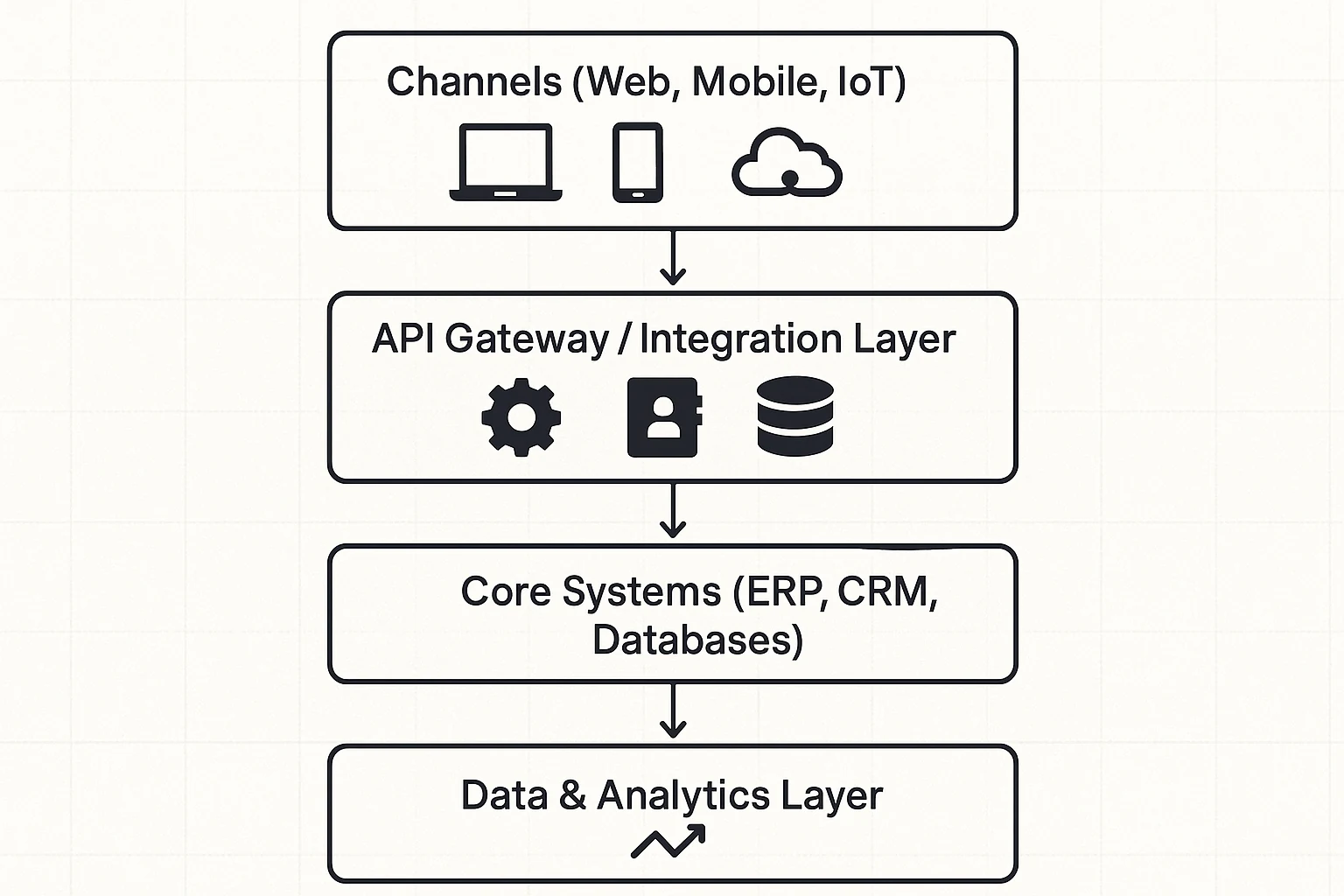
Evolution of Integration: From Monolith to Cloud-Native
In the past, when businesses relied on monolithic applications, integration was often accomplished with heavyweight centralized tools or brittle point-to-point connections. Traditional enterprise integration in the pre-cloud era commonly used an Enterprise Service Bus (ESB) – a centralized hub through which all applications communicated. This provided standardization and governance, but it created a single integration backbone that could become a bottleneck or single point of failure. ESBs were designed for a “pre-cloud, legacy system era” and can be less flexible and slower to adapt than modern approaches. With the rise of cloud computing and microservices, the integration paradigm shifted toward more decentralized, lightweight solutions.
Traditional vs. modern integration
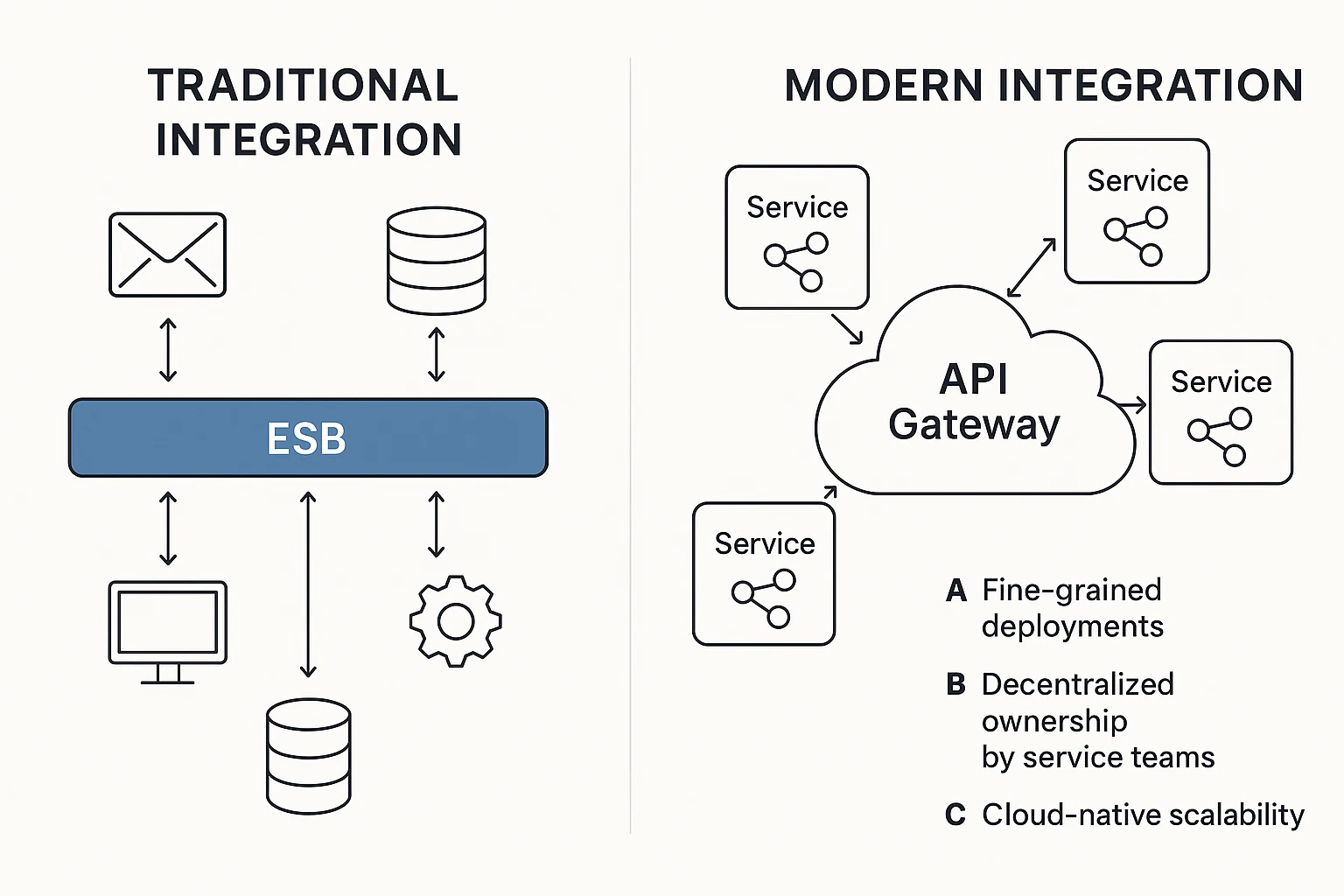
Modern microservices architectures internalize many integration responsibilities within or between services. Instead of funneling all communication through one big bus, each microservice exposes a well-defined interface (often a REST API or event interface) and communicates via lightweight protocols. This approach increases agility and scalability: services can be developed, deployed, and scaled independently, and they connect through standard APIs, messaging, or event streams as needed. In practice, many organizations adopt API-led integration strategies – designing layered APIs (system APIs, process APIs, experience APIs) as building blocks to link services and data in a reusable way. The result is an integration architecture that is more distributed and resilient, aligning with DevOps and cloud principles (for example, using containerized integration components and service mesh infrastructure for internal service-to-service communication).
| Era | Architecture | Integration Approach | Key Characteristics |
|---|---|---|---|
| Pre-Cloud / Monolithic | Large centralized applications | Point-to-Point (P2P), File-based, Batch jobs | Tight coupling, fragile connections |
| SOA Era (2000s) | Service-oriented architecture | Enterprise Service Bus (ESB), SOAP | Centralized control, XML-heavy, slower agility |
| Cloud-Native / Microservices | Distributed services | API-led, Event-Driven, iPaaS | Loose coupling, scalability, composable integration |
In the monolithic world, integrations were built as point-to-point connections — fast for small systems but unmanageable at scale. As integration needs grew, enterprises adopted ESBs to centralize and standardize communication, mediation, and orchestration. Today, cloud platforms favor API-led connectivity and event-driven approaches that are distributed, scalable, and autonomous — aligning with DevOps, CI/CD, and microservices principles.
Next, we’ll explore the common integration architecture patterns that have emerged over time, and how they apply today.
Common Integration Architecture Patterns
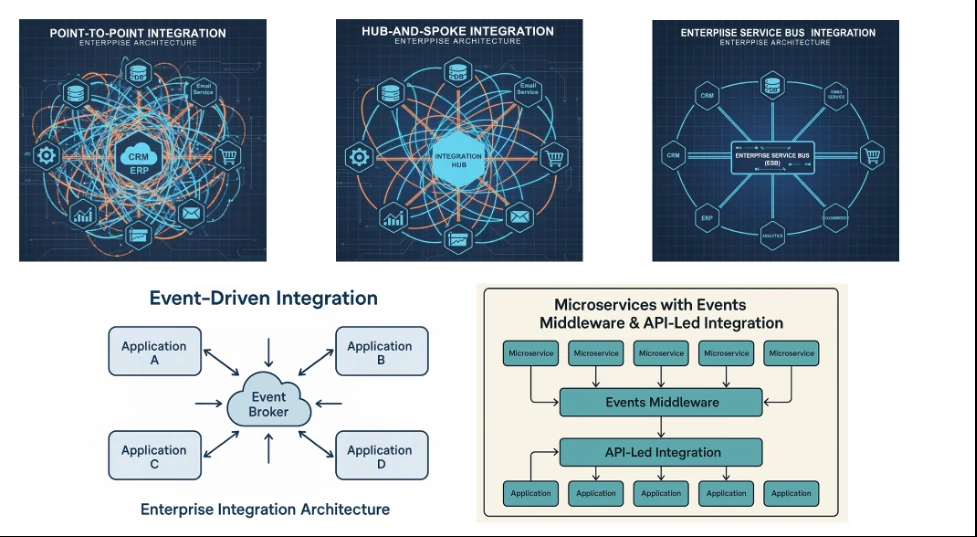
Modern integration is not one-size-fits-all. Enterprises mix multiple patterns depending on system complexity, latency needs, and scalability goals.
| Pattern | Description | Use Case / Example | Advantages | Challenges / Trade-offs |
|---|---|---|---|---|
| Point-to-Point Integration | Simplest form of integration — each pair of systems connects directly via APIs, files, or DB links. No intermediary. Works well for small environments. | An e-commerce app directly calling an inventory API to update stock levels. | • Fast and low latency • Simple to implement • No middleware dependency |
• Becomes “spaghetti” as systems grow • Hard to manage, no central visibility • Duplication of logic and error handling • High maintenance cost |
| Hub-and-Spoke Integration | Introduces a central hub that handles routing and transformation between systems (“spokes”). Reduces number of direct links. | A hub receiving an order from Sales, then sending data to Inventory, Billing, and Shipping systems. | • Fewer interfaces to maintain • Centralized control and monitoring • Easier to add/remove systems |
• Single point of failure if hub goes down • Potential performance bottleneck • Limited scalability if not distributed |
| Enterprise Service Bus (ESB) | Centralized integration middleware (the “bus”) connecting enterprise systems with adapters, mediation, orchestration, and policies. | IBM Integration Bus, Oracle Service Bus, TIBCO, BizTalk integrating CRM, ERP, Finance, Supply Chain. | • Loose coupling between apps • Centralized governance, logging, and security • Reusable adapters and transformations |
• Complex, heavyweight to manage • Adds latency • Can slow agility/change • Risk of becoming a monolithic bottleneck |
| Event-Driven Integration | Systems communicate asynchronously by publishing/subscribing to events via brokers or streams (Pub/Sub). Decoupled and scalable. | Order Service publishes “Order Placed” event → Inventory, Notification, and Analytics services consume it independently. | • Asynchronous, scalable, real-time • Loose coupling between producers/consumers • Resilient (retry/replay possible) • Ideal for IoT and microservices |
• Eventual consistency • Harder to trace/debug flows • Requires event schema governance |
| Microservices & API-Led Integration | Integration built via independent microservices exposing APIs (System, Process, Experience). Often combined with API gateways or service mesh. | API Gateway routes client requests to microservices (Cart, Payment, Inventory). MuleSoft API-led tiers structure connectivity. | • Decentralized and agile • Teams own their services • Highly reusable via APIs • Scales easily in cloud-native environments |
• Distributed complexity • Requires strong governance • Needs observability, DevOps, and version control • Potential data inconsistency across services |
Functionalities of Integration Platforms
Having the right integration platform is vital for implementing these patterns at scale. Instead of writing custom scripts or ad-hoc connectors for every integration, enterprises use dedicated integration tools that provide a framework or “bus” to plug systems into. These tools can be on-premises middleware or cloud-based services (Integration-Platform-as-a-Service, or iPaaS). Their primary purpose is to simplify and manage the connections between systems, so developers don’t have to reinvent plumbing for every project.
| Category | Functionality | Purpose / Example |
|---|---|---|
| Connectivity | Pre-built adapters for SaaS, ERP, Databases, MQs | Connect SAP, Salesforce, Workday, MySQL |
| Data Transformation | Convert and map formats | XML ↔ JSON ↔ CSV conversions |
| Routing & Mediation | Dynamic routing based on rules | Content-based router for customer segments |
| Orchestration | Combine multiple calls into workflows | Order → Payment → Invoice pipeline |
| Messaging | Reliable async processing | Queues, Topics, Retry, DLQ |
| API Management | Security, throttling, analytics | Apigee, Azure API Mgmt, AWS API Gateway |
| Event Handling | Pub/Sub, Streaming | Kafka, EventBridge |
| Security | OAuth2, mTLS, Encryption | Uniform enterprise-wide security |
| Monitoring | End-to-end visibility, SLAs | Logs, metrics, alerting for Ops/SRE teams |
| Governance | Versioning, promotion, audit | Consistency and compliance control |
| Low-Code Tools | Drag-and-drop flow design | Citizen integrator enablement |
| Scalability | Auto-scaling, HA, failover | Cloud elasticity and reliability |
Leading Integration Products and Benefits
The integration software landscape includes both long-standing enterprise suites and modern cloud-native platforms. Here are some of the top integration platforms.
| Platform / Product | Type / Category | Key Strengths & Features | Ideal Use Cases | Notes / Cloud Ecosystem |
|---|---|---|---|---|
| MuleSoft Anypoint Platform | Enterprise Integration Suite / iPaaS | • API-led connectivity (System, Process, Experience APIs) • Unified design, deployment, and monitoring • Strong governance and lifecycle management |
• Large enterprises adopting API-first strategy • Complex hybrid integrations (on-prem + cloud) |
Now part of Salesforce ecosystem; strong fit for digital transformation and omnichannel API enablement. |
| IBM Integration Bus / App Connect | Traditional EAI + Modern iPaaS | • Mature adapters for legacy systems • Enterprise-grade message routing and mediation • Transactional reliability and mainframe connectivity |
• Core system integrations (ERP, CRM, mainframe) • Highly regulated industries needing strong reliability |
Supports both on-prem and cloud-native deployment; robust ESB lineage. |
| Oracle Integration Cloud (OIC) | Cloud iPaaS | • Prebuilt integrations for Oracle SaaS/ERP • Visual process orchestration and monitoring • Tight integration with Oracle Fusion and legacy systems |
• Enterprises running on Oracle ERP / HCM / CX stack • Streamlined automation across Oracle apps |
Focused on Oracle ecosystem; limited extensibility outside Oracle environment. |
| Dell Boomi | Low-Code iPaaS | • Drag-and-drop integration builder • Fast time-to-market with prebuilt connectors • Excellent data transformation and mapping tools |
• Cloud-first organizations • Rapid integration for SaaS apps (Salesforce, Workday, etc.) |
Strong in hybrid and multi-tenant integration; suitable for mid-sized enterprises. |
| Workato | Low-Code / Automation iPaaS | • Business-user-friendly workflow builder • Rich SaaS integrations and recipes • Strong focus on automation and citizen integration |
• Business automation between SaaS platforms • Event-triggered workflows and notifications |
Competes with Zapier (business) but at enterprise-grade scale. |
| SnapLogic | AI-Enhanced iPaaS | • AI-powered integration assistant (“Iris AI”) • High-speed data processing pipelines • Strong support for cloud data warehousing |
• Data integration across SaaS + data platforms • ETL/ELT and analytics-focused integration |
Great fit for data engineering + app integration convergence. |
| Talend Data Integration | Data Integration / ETL Platform | • Robust data extraction and cleansing tools • Big Data and streaming connectors • Open-source and enterprise editions |
• Data pipelines for analytics and governance • Cloud migration and data modernization projects |
Now part of Qlik; strong alignment with data management initiatives. |
| TIBCO Cloud Integration | Hybrid EAI + Cloud Integration | • Supports SOAP, REST, JMS, and event-driven flows • Integration, analytics, and visualization under one suite • Rich ecosystem for legacy modernization |
• Enterprises with mixed legacy + modern systems • Scenarios needing centralized governance |
TIBCO remains strong in event-driven and business process integration. |
| Apache Camel | Open-Source Integration Framework | • Lightweight, developer-centric framework • Implements 80+ Enterprise Integration Patterns (EIPs) • Embeddable within Java/Spring apps |
• Custom-built integrations in Java stack • Developers needing fine-grained control over flows |
Powers many commercial iPaaS tools under the hood; integrates well with Spring Boot, Quarkus, etc. |
| SAP Integration Suite (BTP) | Enterprise Integration Suite (Cloud + Hybrid) | • Deep SAP ERP/S4/HANA integration • Prebuilt connectors for SAP + non-SAP systems • Supports APIs, events, and workflows |
• SAP-centric enterprises with hybrid cloud • Transition from PI/PO to modern API/event-driven patterns |
Runs on SAP BTP; critical for SAP S/4HANA transformations. |
| Microsoft Azure Integration Services | Cloud-Native Integration Suite | • Includes Logic Apps, API Management, Service Bus, Event Grid • Deep integration with Azure ecosystem and Power Platform • Low-code and pro-code flexibility |
• Azure-based hybrid architectures • Cloud-to-on-prem or multi-cloud integration |
Ideal for enterprises standardizing on Azure; strong DevOps and observability support. |
| AWS Integration Services | Cloud-Native Integration & Orchestration | • Services like AppFlow, EventBridge, Step Functions, SQS/SNS • Event-driven and workflow-based integration • Serverless scaling and reliability |
• Cloud-native event-driven systems • Cross-service automation within AWS |
Excellent for modern microservices, IoT, and serverless architectures. |
| Google Cloud Integration Stack | Cloud-Native Integration / API Management | • Apigee for full API lifecycle management • Pub/Sub for asynchronous messaging • Dataflow & Workflows for orchestration |
• API-first enterprises on Google Cloud • Event-driven or streaming data architectures |
Best fit for cloud-native, AI/ML-driven workloads; integrates well with Vertex AI and BigQuery. |
No matter the product, all these integration systems serve a similar role in enterprise architecture. They act as bridges or intermediaries that handle the heavy lifting of data exchange: transforming data between formats, routing messages to the right targets, and orchestrating multi-step workflows across numerous applications. By using a robust integration platform, organizations gain several benefits:
- System Interoperability – Connect legacy, SaaS, cloud, and IoT systems.
- Faster Time-to-Market – Pre-built connectors and templates accelerate delivery.
- Digital Transformation Enablement – Bridge old (ECC) and new (S/4HANA, SaaS) systems.
- Agility & Reusability – Reuse APIs and flows instead of re-coding.
- Data Consistency – Enforce canonical data models across systems.
- Governance & Compliance – Central policy enforcement (GDPR, HIPAA).
- Reliability & Observability – Built-in retry, logging, and dashboards.
- Business-IT Collaboration – Empower low-code integration via visual tools.
- SRE Alignment – Provide telemetry and traceability for integration SLAs.
- Composable Enterprise Foundation – Enable modular, API-driven business capabilities.
Enterprise Integration Patterns (EIP)
Enterprise Integration Patterns (EIP) are a set of design blueprints describing how systems exchange messages and handle common integration scenarios. These patterns are the “grammar” of integration design — much like how design patterns are to software architecture.
They help standardize the way we connect, route, transform, and manage messages across applications.
EIP Categories
| Category | Purpose | How It Applies in Modern Integration Architectures |
|---|---|---|
| Messaging Channels | Define how messages travel between systems (e.g., Point-to-Point, Publish-Subscribe, Dead Letter). | These are the “communication highways” in your architecture. For example, an Event-Driven system uses Publish-Subscribe Channels (like Kafka Topics or Azure Event Grid). A Point-to-Point integration uses a Direct Channel (one sender, one receiver). A Dead Letter Channel ensures reliability when errors occur. |
| Message Construction | Define what the message contains and its intent (Command, Event, Request-Reply). | This relates to data contracts between systems. For example, in API-led integration, you might use Request-Reply (HTTP call to an API). In Event-Driven integration, you use Event Messages (“OrderPlaced”, “InventoryUpdated”). In process orchestration, you may use Command Messages to trigger actions. |
| Routing Patterns | Decide where a message goes (Content-Based Router, Recipient List, Splitter, Aggregator). | These patterns govern logic flow within your integration layer. In an ESB or iPaaS, you can use Content-Based Routing to send high-value orders to one system and standard orders to another. Splitter/Aggregator are key in ETL or microservice composition, where data must be divided or combined. |
| Transformation Patterns | Convert data formats and structures (Message Translator, Content Enricher, Normalizer). | Core to system interoperability — these patterns ensure that SAP, Salesforce, and your custom apps can all understand each other’s data. A Message Translator converts XML to JSON; a Content Enricher adds missing fields (like customer profile info); a Normalizer standardizes varied formats into a canonical model. |
| Endpoint Patterns | Define how systems send or receive messages (Service Activator, Polling Consumer). | These patterns describe entry and exit points of integration flows. For example, a Service Activator is your microservice or API endpoint triggered by incoming data. A Polling Consumer regularly checks a source system (like an FTP folder or database) for new records — common in hybrid integrations. |
| System Management | Enable monitoring, auditing, and control of message flows (Wire Tap, Message Store, Control Bus). | This aligns directly with SRE and observability practices. A Wire Tap lets you log traffic for audit; a Message Store ensures replay/retry; and a Control Bus provides centralized configuration and orchestration. Modern tools like OpenTelemetry, Grafana, and Integration Dashboards bring these to life. |
How These Patterns Connect to Integration Architectures
Let’s connect them to the integration models we discussed:
| Integration Pattern | EIPs in Action | Example |
|---|---|---|
| Point-to-Point | Message Channel + Translator | Direct API call between two systems with format conversion |
| Hub-and-Spoke / ESB | Routing + Transformation + Endpoint | ESB routes messages to the right system, transforms data, and manages retries |
| Event-Driven | Publish-Subscribe Channel + Event Message + Aggregator | Kafka publishes “OrderPlaced” events to multiple subscribers; analytics service aggregates |
| API-Led | Request-Reply + Message Construction + Endpoint | REST APIs exchanging commands and responses via HTTP |
| Microservices Integration | Routing + Transformation + Management | Service Mesh handles routing; logs captured via Wire Tap for observability |
EIP in the Cloud Era
This table illustrates how traditional Enterprise Integration Patterns (EIPs) — originally designed for on-prem middleware — have evolved into modern cloud-native equivalents. Each pattern still solves the same core integration problem, but the technology implementing it has shifted from ESBs and message queues to cloud services like Kafka, Azure Service Bus, AWS Lambda, and OpenTelemetry.
| Pattern | What It Does | Modern Cloud Example |
|---|---|---|
| Message Channel | Provides a virtual pipe for data | Kafka Topic, Azure Service Bus |
| Content-Based Router | Routes based on message content | API Gateway routing logic |
| Message Translator | Converts format between systems | JSON ↔ XML via Function App |
| Aggregator | Combines multiple messages | Dataflow, Kafka Streams |
| Splitter | Splits one message into many | Lambda or Boomi flow splitting |
| Dead Letter Queue | Captures failed messages | Kafka DLQ, EventBridge DLQ |
| Wire Tap | Non-intrusive logging | Cloud Logging, OpenTelemetry tracing |
In short:
- The principles remain timeless; the tools have changed.
- The table maps classical integration building blocks (e.g., routers, translators, aggregators) to modern cloud implementations (API Gateways, serverless, event buses, dataflow pipelines).
- These patterns remain relevant in microservices and event-driven ecosystems — only the technology changed. Today’s Kafka topics, Apigee gateways, or AWS Step Functions all implement EIPs under the hood.
EIP Example Flow — Traditional ESB vs Modern Cloud-Native
Scenario: Customer places an order. We need to translate the payload, route based on order value, and aggregate downstream results before billing.
1) Traditional (ESB/SOA) Implementation
Stack (example): JMS Queue, ESB (e.g., IBM IIB/Oracle SB), XSLT, SOAP Services, RDBMS
Flow:
- Message Endpoint → ESB
- Order (XML) arrives on a JMS queue. ESB picks it up.
- Translator (Message Translator)
- ESB applies XSLT to convert PartnerOrderXML → CanonicalOrderXML.
- Router (Content-Based Router)
- If
order.total >= 1000→ route to PremiumFulfillmentService - Else → route to StandardFulfillmentService
- If
- Parallel Calls + Aggregator
- ESB invokes services (Inventory, Fraud, Tax, PaymentAuth) via SOAP.
- Aggregator waits for all responses (with timeout) and merges to OrderDecisionXML.
- Billing Service (Request-Reply)
- ESB invokes Billing SOAP endpoint with consolidated payload.
- On failure → Dead Letter Channel; retries per policy.
- Observability & Ops:
- ESB dashboard for message tracking, error queues, and audit trail.
- Centralized change control; slower to evolve but strong governance.
[JMS] -> [ESB:Translator] -> [ESB:Router] -> (Premium|Standard) -> [ESB:Aggregator] -> [Billing SOAP]
2) Modern Cloud-Native Implementation
Stack (example): API Gateway, Function/App Service, Kafka (or EventBridge), Microservices, Dataflow/Kafka Streams, OpenTelemetry
Flow:
- API Gateway → Order Service
- Order arrives as JSON (REST). Gateway handles auth, rate limits.
- Translator (Function/App)
- Convert PartnerOrderJSON → CanonicalOrderJSON; enrich with customer profile (cache/service).
- Router (Content-Based)
- If
total >= 1000→ publish toorders.premiumtopic - Else → publish to
orders.standardtopic
- If
- Aggregation (Streaming or Orchestrator)
- Inventory, Fraud, Tax, PaymentAuth services consume events and publish results.
- Aggregator (Dataflow/Kafka Streams/Step Functions) joins results into OrderDecisionJSON with timeouts & partial-failure rules.
- Billing (Sync or Async)
- Orchestrator invokes Billing API (sync) or emits
billing.requested(async). - Failures → DLQ + automated retries; alert via Ops channel.
- Orchestrator invokes Billing API (sync) or emits
- Observability & Ops:
- Traces/metrics via OpenTelemetry; dashboards in Grafana/Cloud Monitoring.
- Independent service deploys; faster iteration with API versions & schema registry.
[API GW] -> [Translator Fn] -> [Router] -> [orders.premium|orders.standard topics] -> [Streaming Aggregator] -> [Billing API]
Key Differences (At a Glance)
- Topology: Centralized ESB vs distributed APIs/events.
- Contracts: XML/SOAP/XSLT vs JSON/REST + Avro/JSON Schemas.
- Scaling: ESB cluster vs independent microservices & serverless.
- Resilience: Central DLQ vs per-topic DLQs + idempotency + retries.
- Observability: ESB console vs end-to-end tracing & logs (OTel).
Takeaway: Same EIPs (Translator → Router → Aggregator), different runtime. Cloud-native spreads responsibilities across APIs, functions, and streams for agility and scale.
🏁 Conclusion
In today’s digital ecosystem, integration architecture is no longer just middleware — it’s the foundation of enterprise agility and resilience.
From monolithic ESBs to cloud-native, API-led, and event-driven designs, the principles of Enterprise Integration Patterns (EIPs) continue to guide how systems communicate, evolve, and scale.
Enterprises that invest in modern integration — built on APIs, events, and observability — gain the flexibility to connect legacy systems, cloud platforms, and AI-driven services seamlessly.
They create a composable architecture that can adapt quickly to new business needs while maintaining governance and reliability.
The future of integration lies in modular, intelligent, and self-healing systems — where EIP concepts meet cloud-native platforms to power the connected enterprise.
Integration is no longer the glue that holds systems together; it’s the bloodstream that keeps the digital enterprise alive.